

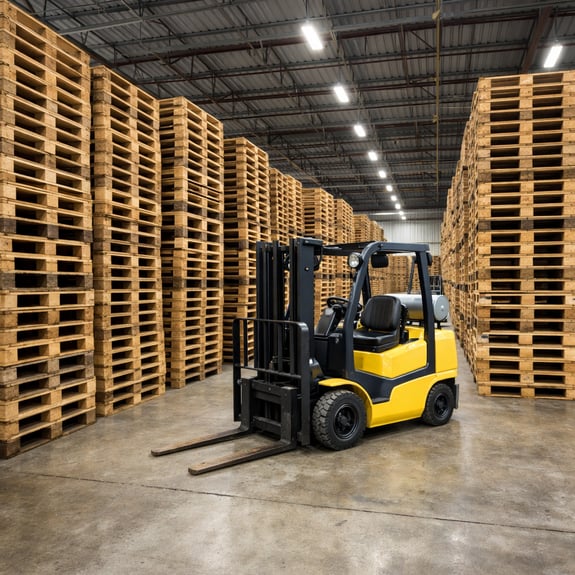
PLA analyzed key macroeconomic and industry-specific data to provide insight into 2026 pallet market behavior. Here’s what retailers and manufacturers can expect for recycled wood pallet demand and pricing in 2026. After a volatile 2025 defined by tariff-driven front-loading, import swings, and stabilizing inventory conditions, we now enter 2026 with leaner supply chains, firming input costs across all correlated markets, and an economy that is resilient, but not without meaningful risk.
What drives Recycled Pallet Pricing?
PLA monitors various macroeconomic and industry-specific indicators that we've determined to have statistically significant correlations to pallet demand and pricing. The full results of this analysis are available here.
At a high level, there are four market drivers of recycled pallet pricing that every pallet user should understand:
-
Demand Indicators (Consumer Spending, Retail Sales, Manufacturers’ Inventories): Consumer Spending, Retail Sales, and Manufacturers’ Inventories are among the strongest demand-side predictors of pallet pricing. Consumer Spending (PCE) showed a statistically significant correlation with a seven-month lag - meaning today’s spending data signals pallet demand half a year out. Retail Sales showed a moderate positive correlation with pallet pricing. Manufacturers’ Inventories - which tracks the value of goods factories hold in raw materials, WIP, and finished goods - emerged as the single strongest positive predictor in PLA’s regression analysis. As inventory levels rise, so does pallet demand to move and store those goods, pushing prices up.
- Recycled Pallet Companies' Inventories: When recycled pallet companies sit on high levels of core or finished goods inventory, they typically offer lower prices to move that inventory. Conversely, when inventories are low, prices increase. After record-high inventories in 2024, recycler inventory levels normalized through 2025 and entered 2026 at historical norms across most markets.
- Core Pricing: Cores are almost always the largest single cost in a recycled pallet. Core supply is driven by retail sales velocity and inventory levels - the longer retailers hang on to product in their DCs, the fewer cores enter the market. With retailer inventories lean and seasonal patterns returning to normal, core availability in 2026 is expected to stabilize relative to the past two years.
- Lumber Pricing: Recycled pallets first enter the supply chain as new pallets, and higher lumber costs mean higher costs to build new pallets. When new pallet prices rise, some users switch to combo or recycled A-grade pallets to reduce costs, increasing demand and pricing for all recycled grades. The impact is not felt immediately, but following periods of elevated lumber costs, elevated recycled pallet pricing typically follows. As our quarterly updates documented throughout 2025, lumber has been trending higher year-over-year every quarter - a trend expected to continue into 2026.
With a foundation of these main drivers of recycled pallet pricing, we can understand what happened in the wood pallet market in 2025 and, more importantly, know what to expect in 2026.
Understanding the 2025 WOOD Pallet Market
2025 was a year of transition: a recovery from the historic demand stagnation and core glut of 2024, complicated by one of the most turbulent tariff environments in modern US. trade history. PLA’s quarterly indicator analysis captured the full arc of the year.
A Tale of Four Quarters
Q1: Tariff-Driven Front-Loading Surge
As documented in PLA’s Q2 2025 Update, imports surged 36% (annualized) in Q1 2025 — the largest single-quarter increase since Q3 2020 - as businesses front-loaded imported goods ahead of impending tariffs. Manufacturers’ inventories rose for a sixth consecutive month (+2.1% annualized), and lumber prices climbed 2.9% in the quarter, up 8.5% year-over-year (FRED: WPU081). Retail sales rose 2.2%, buoyed by a strong March. Recycled Paperboard Pricing rose for its fourth straight quarter (+1.1%, FRED: WPU09141105). The bottom line from Q1: pallet demand and pricing were strong, and the upward pressure expected in PLA’s January 2025 annual outlook was materializing.
Q2: The Tariff Hangover
PLA’s Q3 2025 Update captured the reversal. Imports plunged 35% (annualized) in Q2, reversing Q1’s extraordinary surge. Retail sales were essentially flat (+0.2% vs. Q1). Consumer spending on goods rose only +0.5% (2.1% annualized), with discretionary categories weakening and staples holding. Lumber pricing dipped slightly (-0.2%) but remained 7.3% above prior year. OCC/Recycled Paperboard Pricing rose another 2.4% - its fifth consecutive quarterly increase. PLA’s Q2 bottom line: near-term import-driven pallet demand would remain strong (due to another July front-loading wave), but the H2 import slowdown would begin to ease pallet price pressure.
Q3-Q4: Normalization and Stabilization
As detailed in PLA’s Q4 2025 Update, Q3 brought a final import surge in July and August (above 2.3M TEUs) before September imports fell 8.4% from August and Q4 imports dropped 7.5-7.8% year-over-year. Manufacturers’ inventories held essentially flat at $946.8B in September. Retailers entered the holiday season with lean, well-positioned inventory, and the National Retail Federation forecast holiday 2025 sales to exceed $1 trillion for the first time, growing 3.7-4.2%. Recycled Paperboard Pricing rose a modest 0.8% in Q3 but stood 6.1% above the prior year. Lumber eased slightly in Q3 (-2.5%) but remained nearly 5% above year-ago levels. PLA’s Q4 bottom line: stable recycled pallet prices into year-end, with limited downside unless consumer demand meaningfully softened.
The 2025 Data at a Glance
The table below summarizes how PLA’s seven tracked indicators performed across 2025, based on the quarterly update series:
|
Indicator |
Q1 2025 |
Q2 2025 |
Q3–Q4 2025 |
Full-Year Direction |
|
Manufacturers’ Inventories |
+2.1% ann. |
Flat (+0.14%) |
Flat; ISM contracting |
+1.1% |
|
Imports |
+36% ann. |
−35% ann. |
July surge then −8% YoY Q4 |
+2.7% |
|
OCC/Recycled Paperboard |
+1.1% |
+2.4% |
+0.8%; +6.1% YoY |
+6.4% |
|
Retailers’ Inventories |
−0.1% |
+0.5% |
Flat; lean entering Q4 |
+2.4% |
|
Consumer Spending (Goods) |
+0.5% ann. |
+0.5% ann. |
Slowing; value-driven |
+3.2% |
|
Lumber PPI |
+2.9%; +8.5% YoY |
−0.2%; +7.3% YoY |
−2.5%; +5% YoY |
+4.8% |
|
Retail Sales |
+2.2% |
+0.2% |
Modest; NRF +3.7-4.2% |
+3.8% |
Full-year figures represent 2025 annual average vs. 2024 annual average. Source: FRED.
2025 SUMMARY
As PLA's quarterly updates documented in real time, recycled pallet pricing stabilized and modestly firmed through 2025 after the significant declines of 2024. The year was shaped by two countervailing forces: the extraordinary tariff-driven import front-loading (which created temporary spikes in pallet demand in Q1 and again in July) and the subsequent pullback as those imports normalized. Underlying demand - anchored by essential goods categories like food, beverage, and household products - remained steady throughout.
Recycler inventories, which had been at record highs through 2024, normalized to historical levels. OCC/Recycled Paperboard Pricing rose every single quarter of 2025, averaging +6.4% above 2024 levels on a full-year basis - a consistent forward signal for pallet pricing strength. Lumber PPI averaged +4.8% above 2024 on a full-year basis, keeping sustained upward pressure on new pallet input costs throughout the year.
2026 Wood Pallet Market Outlook
We enter 2026 with the seven indicators PLA tracks all pointing in the same direction: upward pressure on recycled pallet demand and pricing. The import distortions that complicated 2025’s picture are behind us. What remains is a fundamentally constructive demand environment, lean inventory positions throughout the supply chain, and supply-side constraints - particularly in lumber - that will translate directly into higher pallet costs.
Demand: Positive Momentum, Moderated by Uncertainty
The economic consensus entering 2026 is cautiously constructive. RSM Chief Economist Joe Brusuelas projects above-trend U.S. real GDP growth of 2.2% for 2026, supported by the 2025 tax reconciliation package, Fed rate cuts totaling 175 basis points since September 2024, and ongoing deregulation tailwinds. Deloitte forecasts 1.9% real GDP and 1.6% real consumer spending growth, reflecting a more value-conscious consumer amid a cooling labor market. Morgan Stanley expects the economy to slow in H1 before reaccelerating in H2, reaching 1.8% real GDP for the year.
For the seven indicators PLA tracks, the 2026 setup differs importantly from 2025 in one critical way: the tariff-driven import distortions are gone. In 2025, extraordinary Q1 import front-loading (up 36% annualized) inflated apparent demand, then crashed in Q2 (down 35% annualized), masking the underlying demand picture. In 2026, we start the year with normalized import flows, meaning that incremental consumer spending and retail sales growth will translate more cleanly and directly into pallet demand, as it has historically.
Retail sales growth of 3-4% is consistent with historical ranges that support steady pallet pricing. The NRF’s forecast for 2026 retail sales aligns with Deloitte’s and The Conference Board’s projections of stable growth in essential categories. Manufacturers’ inventories, which ended 2025 with a contracting ISM Inventories Index (45.8 in October 2025), may provide some near-term softness but create upside as replenishment cycles kick in.
Imports: Normalized Flows, One New Wild Card
After the extraordinary volatility of 2025, from Q1’s +36% surge to Q4’s -7.8% year-over-year decline, import volumes are expected to normalize in 2026. The NRF/Hackett Global Port Tracker projected full-year 2025 imports down 5-6% from 2024 and does not anticipate a repeat of the front-loading behavior that distorted 2025 flows. This normalization is actually positive for pallet demand: as PLA’s Q3 2025 Update noted, the tariff-driven demand was “tied specifically to the unusual import climate instead of reflecting strong underlying demand.” In 2026, import-driven pallet demand will reflect real economic activity, providing a cleaner and more sustainable signal.
The one new wild card: the elimination of the de minimis exemption for low-value parcels (effective August 29, 2025), which is gradually shifting small-parcel import volume toward containerized palletized freight as parcel economics deteriorate for Asian e-commerce shipments. This structural shift is a longer-term positive for pallet demand that will continue building through 2026.
OCC / Recycled Paperboard: Sustained Upward Signal
OCC/Recycled Paperboard Pricing rose in every single quarter of 2025, averaging +6.4% above 2024 levels on a full-year basis. As PLA’s quarterly updates consistently noted, this indicator is highly correlated with recycled pallet pricing - it is one of the most reliable forward signals in our toolkit. Mills have announced continued pricing actions into Q1 2026. Fastmarkets projects another containerboard price increase in early 2026, and Rabobank’s Q3 2025 containerboard report projects North American containerboard demand to recover at a 2.82% CAGR through 2027, with operating rates improving to approximately 92% by mid-to-late 2026. Multiple mill closures in 2025 (Smurfit Westrock, International Paper, Greif) removed over 2 million tons of capacity, tightening the supply-demand balance.
What this means for the pallet market: the sustained OCC/paperboard pricing trajectory that PLA tracked throughout 2025 is pointing upward into 2026, consistently signaling continued recycled pallet price strength.
Retailers’ Inventories: Lean and Getting Leaner
As PLA’s Q4 2025 Update documented, retailers entered the 2025 holiday season with clean, lean inventories after years of post-pandemic overstocking and gradual drawdown. The ISM Services Inventory Sentiment Index remained above 60 through Q3 - meaning retailers themselves reported feeling stocks were “too high” - but retail inventories ended 2025 at significantly leaner levels as holiday sell-through was strong.
What this means for the pallet market: Recall from PLA’s core framework: declining retail inventories are inversely correlated with recycled pallet prices. With retailers entering 2026 lean and holiday replenishment cycles beginning in Q1, inventory restocking should drive consistent inbound pallet demand throughout the year.
Lumber: a major Cost Driver for 2026
As PLA’s quarterly updates tracked throughout 2025, lumber PPI (FRED: WPU081) stayed elevated year-over-year in every quarter despite some intra-quarter volatility. Entering 2026, the structural supply situation has tightened further. U.S. tariffs on Canadian softwood lumber- raised to over 35% in August 2025 and now at combined duties of approximately 45% entering 2026 - have materially constrained supply. Canadian lumber production was down 6.9% in 2025, and major producers including West Fraser, Domtar, and Interfor announced additional facility closures and curtailments throughout H2 2025.
Lumber futures have recovered from a December 3, 2025 cycle low of $526.50/mbf and were trading approximately $595-600/mbf in late January 2026 (Barchart/CME). Russ Taylor Global projects a sharp price surge by Q2 2026 driven by ongoing trade barriers and tightening supply. The NAHB cautions that “the outlook for lumber production and pricing in 2026 remains highly uncertain” but notes that combined duties at current levels are creating structural supply disruption. The spring construction season arrives in a market where production has been significantly curtailed, pointing to meaningful price appreciation from current levels.
What this means for the pallet market: As PLA’s framework explains and as the quarterly data confirmed throughout 2025, higher lumber costs push new pallet prices up, which then drives demand from recycled grades as cost-sensitive users substitute. This effect, which was building steadily through 2025, should accelerate in 2026.
Consumer Spending and Retail Sales: Steady but Value-Driven
Consumer spending on goods showed moderate but consistent positive growth throughout 2025, despite rising inflation and weakening consumer confidence. As PLA’s quarterly updates noted, essential goods categories - food, beverage, household products, general merchandise - were the consistent anchors of pallet demand even as discretionary categories softened. This bifurcation is expected to continue into 2026. Deloitte forecasts 1.6% real consumer spending growth for 2026, positive but modest. The Conference Board projects retail sales growth in the 3-4% range for the year, supportive of stable palletized goods movement.
What this means for the pallet market: The value-seeking consumer behavior documented in PLA’s Q4 2025 Update - trading down within categories, leaning into promotions - may actually benefit the recycled pallet market as retailers respond by increasing velocity in essential and private-label goods, which tend to be highly palletized.
2026 Forecasted Performance: All Seven Indicators
Sources: Federal Reserve (FRED), RSM, Morgan Stanley, Deloitte, The Conference Board, NAHB, Fastmarkets, Rabobank, C.H. Robinson, FreightWaves, NRF, ACT Research, PLA Analysis
|
Indicator |
2026 Forecast |
Pallet Market Signal |
|
Manufacturers’ Inventories |
Modest increase |
↑ Positive |
|
Imports |
Stable, normalized |
→ Stable/Positive |
|
OCC/Recycled Paperboard |
Continued increases |
↑ Upward |
|
Retailers’ Inventories |
Near historic lows |
↑ Upward pressure on prices |
|
Consumer Spending (Goods) |
Moderate growth |
→ Stable/Positive |
|
Lumber PPI |
Sharp increases |
↑ Upward; cost-push to recycled |
|
Retail Sales |
Moderate growth |
↑ Positive |
Sources: Federal Reserve (FRED), RSM, Morgan Stanley, Deloitte, The Conference Board, NAHB, Fastmarkets, Rabobank, NRF, PLA Analysis
Result for 2026: The Cycle Has Turned
The combination of signals PLA tracks points unambiguously toward higher recycled pallet prices in 2026. The result is driven by the convergence of all seven indicators simultaneously pointing in a constructive direction for the first time since 2022 - a sharp contrast to the 2024-25 period where demand indicators were positive but inventory gluts suppressed pricing.
First Half 2026: Price increases will be led by A-grade pallets as lumber cost increases push new pallet pricing higher, driving cost-sensitive users toward recycled alternatives. B-grade GMA pricing will see firming in markets where recycler inventories have been drawn down to or below target levels. Lean retail inventories and the beginning of restocking cycles will support consistent inbound pallet demand. The OCC/paperboard signal - which rose every quarter of 2025 - points to continued upward correlated pressure.
Second Half 2026: As spring construction demand tightens lumber supply further and any tariff reimposition materializes (following the February 21, 2026 Supreme Court ruling that voided some IEEPA-based tariffs), broader price increases across all grades are expected. Import normalization means pallet demand will reflect actual economic activity rather than artificial front-loading. By H2 2026, expect the recycled pallet market to be firmly in a pricing upcycle not seen since 2022.
Key Risks to Watch
Tariff Policy Volatility: On February 21, 2026, the U.S. Supreme Court overturned significant IEEPA-based tariffs. As Fed Governor Waller noted in his February 23, 2026 remarks, the administration “plans to reimpose at least some tariffs using other laws.” This creates a fluid policy environment. If tariffs are significantly reduced, Canadian lumber supply could rebound faster than forecast, moderating lumber-driven price pressure. Conversely, aggressive reimposition would accelerate the upward trajectory. Pallet users should monitor tariff developments closely, as the direction of lumber specifically has outsized downstream impact.
Consumer Demand Softening: As PLA’s quarterly updates tracked in 2025, goods spending growth was consistently moderate, and discretionary categories showed weakness. If value-seeking behavior deepens into essential categories in 2026, or if the cooling labor market creates broader spending contraction, the demand underpinnings of the 2026 pallet outlook would weaken. The annual payroll revision risk noted by Fed Governor Waller - suggesting 2025 employment may have been weaker than initially reported - is a meaningful uncertainty.
Import Normalization Overshoot: After two years of extraordinary tariff-driven import volatility, there is a risk that import volumes undershoot normalized levels in 2026 as global trade flows re-route away from the US. PLA’s Q3 and Q4 2025 Updates both noted that the import-driven pallet demand in 2025 was “tied to the unusual import climate,” not structural demand. A multi-year reduction in US import volumes would dampen pallet throughput at ports and DCs.
Manufacturer Inventory Overhang: The ISM Manufacturing Inventories Index contracted to 45.8 in October 2025 and Customers’ Inventories were signaled as “too low,” suggesting downstream lean conditions. However, if manufacturers respond by cutting production rather than replenishing inventories, pallet demand from manufacturing channels could be soft in early 2026.
Opportunities for Pallet Users
- Review Your Pallet Specifications: A-grade price increases are already underway in markets where recycler inventories have normalized. With lumber averaging +4.8% above 2024 levels on a full-year basis and futures pointing higher into Q2 2026, review your current pallet specs relative to your customer and operational requirements to identify opportunities to shift volume to a lower-cost spec. Proactively building supply chain flexibility before broader Q2–H2 increases arrive is the optimal window.
- Consolidate Your Pallet Program with PLA: As the market tightens at different rates across regions, managing multiple suppliers creates pricing exposure and supply risk. Consolidating your pallet program with PLA gives you national coverage, consistent pricing, and a single partner with the market intelligence and inventory depth to protect your supply chain through the upcycle.
- Map Your Pallet Flows for Cost Reduction: Review each location's pallet purchases, use, and core volumes. Some high-volume facilities may be able to lower costs with an on-site or off-site repair and return program. As B-grade prices firm into H2, building efficient core return flows now can meaningfully reduce total pallet costs. Some facilities may also be candidates for freight-sharing programs.
- Lock in Agreements Strategically: Given the asymmetric upside risks in H2 2026 - particularly if tariffs are reimposed and lumber prices spike during the spring construction season - pallet users with flexibility to contract pricing in Q1-Q2 should evaluate doing so for A-grade and combo volumes where lumber cost transmission is most direct and most immediate.
The supply chain and logistics experts at PLA are knowledgeable about each market and ready to help you develop your 2026 pallet program. Drop us a line and see how we can help.
Sources: PLA Quarterly Market Updates: Q2 2025 | Q3 2025 | Q4 2025 | PLA 2025 Annual Outlook (plasolutions.com) | Federal Reserve Bank of St. Louis (FRED): Manufacturers' Inventories (AMTMTI); Retailers' Inventories (RETAILIMSA); Real Imports of Goods & Services (IMPGSC1); Real Consumer Spending on Goods (DGDSRX1); Retail Sales (RSXFS); OCC/Recycled Paperboard PPI (WPU09141105); Lumber PPI (WPU081) | NRF: 2026 Retail Sales Forecast | NRF/Hackett Global Port Tracker | RSM U.S. Economic Outlook 2026 | Deloitte U.S. Economic Forecast 2026 | Morgan Stanley Global Economic Outlook 2026 | The Conference Board U.S. Economic Forecast | NAHB Framing Lumber Prices | Russ Taylor Global (via ScrapMonster) | Fastmarkets: Containerboard/OCC Outlook | Rabobank North America Containerboard Report Q3 2025 | ISM Manufacturing Report on Business (Oct–Nov 2025) | Federal Reserve Governor Waller, Remarks on Economic Outlook (Feb 23, 2026) | PLA Internal Data
